
The false claims from Jack Perry continue.
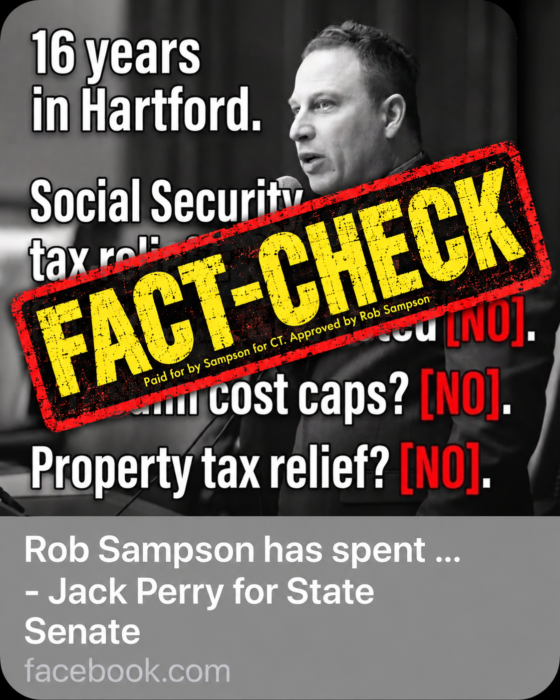
FACT CHECK: JACK PERRY’S LATEST CLAIMS ABOUT MY RECORD
Jack Perry’s latest attack is false. It does not merely leave out a little context. It gives voters the opposite impression of what my actual legislative record shows.
Perry says I oppose Social Security tax relief and property-tax relief. The receipts below show that I have proposed eliminating Connecticut’s income tax on Social Security every year since 2014, and the public Connecticut General Assembly record documents proposals in each of the last seven consecutive years, 2020 through 2026, to exempt or expand the exemption for Social Security, pension, and annuity income. I have also repeatedly proposed direct property-tax relief, caps on property-tax growth, and restrictions on unfunded state mandates that drive up local taxes.
That is why I object so strongly to this latest attack. Candidates can disagree about policy. They can criticize votes. They can argue that a different approach would have been better. But taking one vote against a massive state budget and telling voters that it means I oppose Social Security or property-tax relief, while ignoring years of legislation I personally introduced to accomplish those very things, is a false portrayal of my record.
The history matters too. Connecticut’s broad-based personal income tax was enacted in 1991 while Democrats held majorities in both chambers of the General Assembly, and it was signed by Independent Governor Lowell Weicker. Legislators in both parties divided over it. Today, Democrats again hold large legislative majorities, including 25 of 36 seats in the State Senate. Those majorities control committee leadership and the legislative agenda. Year after year, my proposals to eliminate or reduce taxes on Social Security and retirement income have been introduced, and year after year they have failed to advance to a final vote.
I have spent my legislative career arguing for lower taxes, less spending, fewer unfunded mandates, lower utility costs, and more responsibility from state government. Democratic majorities have written and passed the overwhelming majority of Connecticut’s budgets and statewide policy during the period in which they have controlled the legislature. Voters should judge both records using the actual bills and votes, not a campaign graphic.
So here are the receipts.
SOCIAL SECURITY, PENSION AND RETIREMENT INCOME
I have proposed eliminating Connecticut’s income tax on Social Security every year since 2014. Rather than ask anyone to take my word for it, here are seven consecutive years from the public legislative record:
2020, SB 34
“AN ACT EXEMPTING SOCIAL SECURITY BENEFITS AND PENSION AND ANNUITY INCOME FROM THE PERSONAL INCOME TAX.”
https://www.cga.ct.gov/2020/TOB/S/PDF/2020SB-00034-R00-SB.PDF
2021, SB 292
“AN ACT EXEMPTING SOCIAL SECURITY INCOME AND PENSION AND ANNUITY INCOME FROM THE PERSONAL INCOME TAX.”
https://www.cga.ct.gov/2021/TOB/S/PDF/2021SB-00292-R00-SB.PDF
2022, SB 67
This proposal would eliminate the personal income tax on Social Security benefits regardless of income and exempt pension and annuity income.
https://www.cga.ct.gov/2022/TOB/S/PDF/2022SB-00067-R00-SB.PDF
2023, SB 708
This proposal would eliminate the qualifying income thresholds for the deductions for Social Security benefits and pension or annuity income.
https://www.cga.ct.gov/2023/TOB/S/PDF/2023SB-00708-R00-SB.PDF
2024, SB 31
Again, I proposed eliminating the qualifying income thresholds for the deductions for Social Security benefits and pension or annuity income.
https://www.cga.ct.gov/2024/TOB/S/PDF/2024SB-00031-R00-SB.PDF
2025, SB 735
“To exempt Social Security benefits and pension or annuity income for all taxpayers from the personal income tax.”
https://www.cga.ct.gov/2025/TOB/S/PDF/2025SB-00735-R00-SB.PDF
2026, SB 70
Once again: “To exempt Social Security benefits and pension or annuity income for all taxpayers from the personal income tax.”
https://www.cga.ct.gov/2026/TOB/S/PDF/2026SB-00070-R00-SB.PDF
Seven consecutive years. And that is only the most recent part of a record that goes back to 2014.
So what exactly is Perry calling a “NO” vote?
He is pointing to my vote against SB 1, the 2026 state budget and implementer. That was not a stand-alone vote on Social Security. It was an enormous state budget bill dealing with appropriations, taxes, bonding, revenue, school construction, and many other policy matters. Yes, the final package contained Social Security tax relief and a property-tax credit. It also contained a great deal of other spending and policy that I opposed.
Here is SB 1:
https://cga.ct.gov/asp/CGABillStatus/cgabillstatus.asp?bill_num=SB1&selBillType=Bill
A legislator does not get to vote separately on every line of a massive omnibus budget. The vote is on the whole package.
And there is an important part of that debate Perry leaves out. I co-offered and supported Senate Amendment B, LCO 5764, an alternative affordability package. According to the General Assembly’s nonpartisan Office of Fiscal Analysis, that amendment would have reduced the three lowest personal income-tax rates, producing an estimated $750 million tax reduction in FY 2027 and approximately $1.6 billion in FY 2028 and annually thereafter.
Official OFA fiscal note:
https://www.cga.ct.gov/2026/fna/pdf/2026SB-00001-R00LCO05764-FNA.PDF
So yes, I voted against the final budget package. I also supported an alternative that would have delivered very substantial broad-based tax relief.
That is the context Perry’s graphic erases.
Here is a video of my remarks on this budget and the Republican alternative from the Senate floor:

PROPERTY TAX RELIEF
Perry’s “Property tax relief? [NO]” claim is just as misleading when compared with the legislation I have actually proposed.
In 2022, I introduced SB 66 to increase Connecticut’s property-tax credit to $500 and eliminate eligibility restrictions.
https://www.cga.ct.gov/2022/TOB/S/PDF/2022SB-00066-R00-SB.PDF
That same year I sent the Finance Committee a detailed property-tax reform proposal calling for:
- restoration of a $500 property-tax credit;
- a statutory cap limiting annual property-tax growth to 2 percent or the rate of inflation, whichever was lower; and
- a two-thirds vote of the General Assembly before imposing a new state mandate on municipalities.
Original 2022 proposal:
https://sampsonforct.com/receipts/2022-sampson-property-tax-reform.pdf
In 2023, I introduced SB 496, “AN ACT RESTRICTING PROPERTY TAX GROWTH AND THE IMPOSITION OF NEW MANDATES ON MUNICIPALITIES.”
Its stated purpose was to cap annual property-tax growth and require a two-thirds vote of the General Assembly for new mandates on municipalities.
https://www.cga.ct.gov/2023/TOB/S/PDF/2023SB-00496-R00-SB.PDF
In 2024, I submitted the property-tax reform proposal again, calling for a statutory cap on property-tax growth and a two-thirds vote before the legislature could impose new municipal mandates.
Original 2024 proposal:
https://sampsonforct.com/receipts/2024-sampson-property-tax-reform.pdf
In 2025, I introduced SB 232, again proposing a cap on annual property-tax growth and a two-thirds legislative vote before imposing new municipal mandates.
AN ACT RESTRICTING PROPERTY TAX GROWTH AND THE IMPOSITION OF NEW MANDATES ON MUNICIPALITIES.
I also introduced SB 233 to identify unfunded municipal mandates that could be eliminated to produce savings for taxpayers.
AN ACT ESTABLISHING A WORKING GROUP TO REVIEW UNFUNDED MUNICIPAL MANDATES.
I have also fought the less-visible ways Hartford increases local property taxes.
I am a strong advocate for the state meeting its education-funding responsibilities to municipalities so towns are not forced to make up the difference through local property taxes. I have consistently opposed pushing additional state costs and mandates onto municipalities.
One example is teacher pensions. The Teachers’ Retirement System is a state-run system. Proposals have been made to shift part of those state costs onto municipalities. Municipal officials warned during consideration of such legislation that towns could be forced to raise taxes, reduce services, or use reserves to absorb those costs.
2017 HB 7050:
https://www.cga.ct.gov/2017/FC/2017HB-07050-R000764-FC.htm
Committee record and municipal testimony:
https://www.cga.ct.gov/2017/JFR/h/2017HB-07050-R00FIN-JFR.htm
Moving a state expense onto a town does not make the cost disappear. It simply changes which tax bill you see it on.
The same principle applies to state mandates that make municipal construction and services more expensive. In 2026 I again asked the legislature to change the prevailing-wage threshold for municipal renovation projects. My proposal expressly states that the change could “significantly reduce the costs” of municipal infrastructure and “pass the savings onto local property taxpayers.”
Original 2026 proposal:
https://sampsonforct.com/receipts/2026-sampson-municipal-cost-property-tax-relief.pdf
I also again proposed requiring a two-thirds legislative vote before creating or enlarging a state mandate on local governments:
https://sampsonforct.com/receipts/2026-sampson-unfunded-municipal-mandates.pdf
Does that sound like a legislator who opposes property-tax relief?
THE INSULIN VOTE
Perry also reaches all the way back to the July 2020 special session for an insulin vote.
Yes, I voted against HB 6003.
And I explained exactly why, on the Senate floor, at the time.
My objection was never that insulin should cost more. My objection was that the bill did not reduce the underlying price of insulin. It capped what certain insured consumers paid out of pocket and shifted the remaining cost through the insurance system. My concern, as with other insurance mandates, was that the cost would ultimately show up elsewhere, including in premiums.
People can disagree with that policy analysis. What they should not do is pretend that my position was opposition to lower insulin costs.
My actual floor remarks are here:

Official Senate transcript:
https://cga.ct.gov/2020/trn/S/pdf/2020STR00728-R00-TRN.pdf
Perry wants to accuse me of driving up insurance costs, then attack me for voting against a mandate because I believed it would raise costs elsewhere in the insurance system. Those arguments cannot simply be reduced to a red “[NO]” without explaining what the legislation actually did and why I voted as I did.
ABOUT MY “NO” VOTES
Perry also advertises that I have frequently voted “no,” sometimes as the only senator doing so.
That part does not embarrass me.
I have cast thousands of votes in the legislature. Some were easy. Others involved hundreds of pages of spending, taxes, mandates, regulations, criminal-justice policy, energy policy, and unrelated provisions bundled into a single bill.
A roll-call tally tells you whether I voted yes or no. It does not tell you what was in the bill.
I have voted no on bills because I believed they spent too much, taxed too much, imposed unfunded mandates, increased utility costs, weakened public safety, or bundled good provisions together with policies I could not support.
If I believe a bill is wrong for the people I represent, I vote no, whether I am joined by thirty-five senators or none.
The right way to judge those votes is to read the legislation and listen to the debate.
That is why I am providing the actual documents.
MY CHALLENGE TO JACK PERRY
Since Jack Perry has chosen to make these specific allegations about my legislative record, I am publicly inviting him to debate them.
Let’s sit down with the bills, votes, transcripts, and proposals in front of us.
We can do it live and in person.
We can do it on the radio.
We can do a podcast.
We can do a Facebook Live.
I am comfortable with any reasonable public format.
I will bring the legislation and the receipts. He can bring the evidence he believes supports his claims.
Voters can watch the discussion and decide for themselves.
DOCUMENTING THIS RESPONSE
I am posting this response directly on the Jack Perry for State Senate Facebook page, and I am taking screenshots documenting that it was posted.
(15) Rob Sampson has spent 16 years in… – Jack Perry for State Senate | Facebook
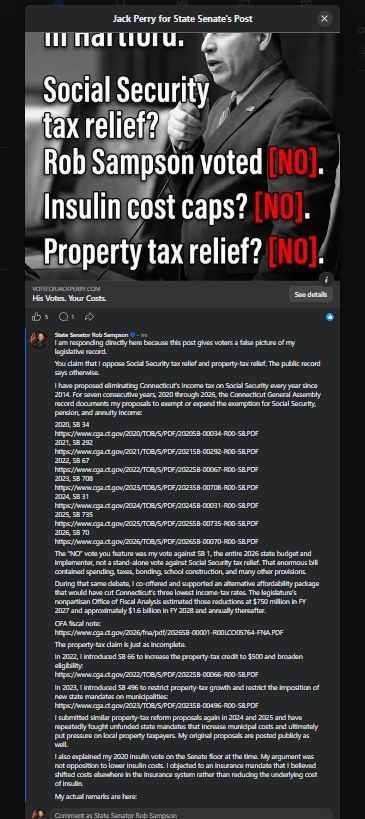
I am doing that for a reason. My comments and the comments of others have previously been deleted from his page, and I have previously been blocked from commenting there.
If this response disappears, I want the public record to show that I answered his claims directly and provided the underlying evidence.
I am also publishing this on my own social-media pages and preserving it permanently at:
https://sampsonforct.com/truth
This is bigger than one campaign graphic.
Voters deserve an argument based on the complete record. They deserve to know what legislation actually said, what alternatives were offered, and why votes were cast.
My record is public.
The bills are public.
The transcripts are public.
The receipts are above.
I welcome anyone, including my opponent, to read them.
Comments are closed